CS 1
Lecture 19
Professor Devin Balkcom
devin@cs.dartmouth.edu
office: Sudikoff 211
Reminders
- Two short assignments this week.
- Tomorrow is last day to withdraw.
Current minimum threshholds for grades:
- It will require at least a 90 to get an A- (possibly higher)
- It will require at least an 80 to get a B-
- It will require at least a 70 get a C-
- It will require at least a 55 to get a D (passing)
Data structures
Data structures:
- store data
- provide methods for accessing data
- form the basis for algorithms that manipulate data
- are used for bookkeeping for apprently unrelated algorithms
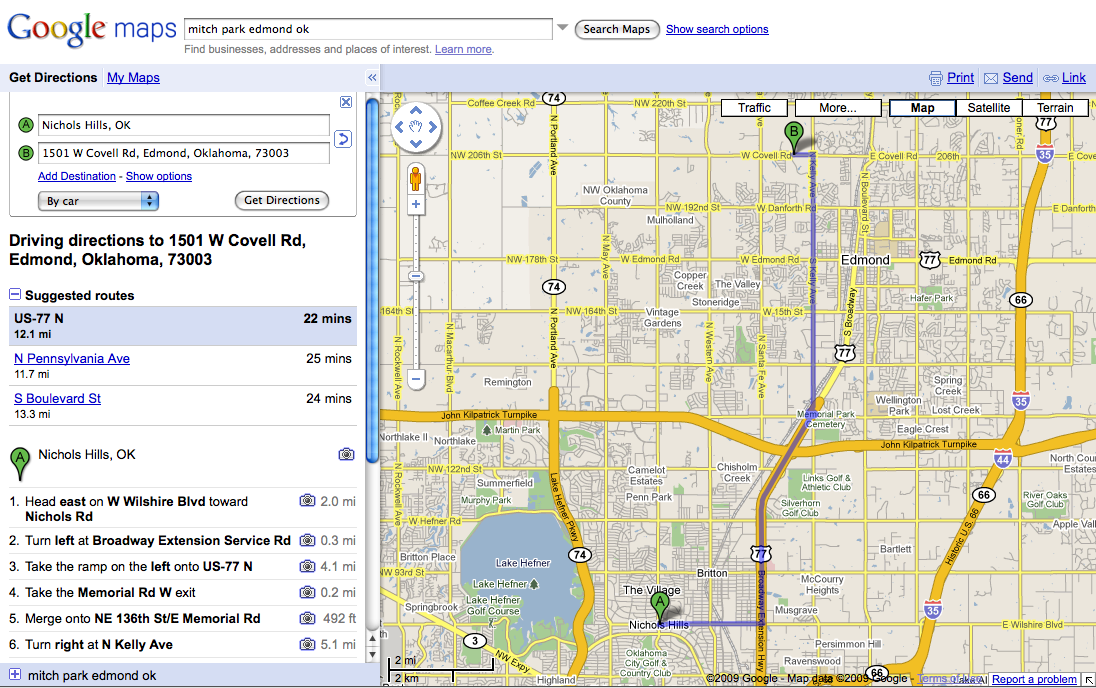
Google maps
How does this work? Soon, we'll see graph search.
Linked lists
Python lists and linked lists provide the same operations: insert, delete, append, find, replace.
Lists are our first example of an abstract data type: a set of operations, but no specified implementation. Python lists and linked lists are implementations of the 'list' abstract data type.
Different implementations of lists:
- same operations may have different run-times
- Linked lists are special cases of graphs and trees
Python list run-time
Worst cases:
- $\Theta(1)$ access by index, using address computation.
- $\Theta(n)$ insertion, by shifting items to the right.
- $\Theta(n)$ append. (What? Why?)
Python list: append
Naive $\Theta(n)$ approach to appending:
- Make a new area in memory that is one element larger.
- Copy old list into new area.
- Add the new item.
- Automagically update address of all list variables.
Python list: append
Summary: shed full, build new shed one log larger.

Python list: append
Smarter approach to append: plan for the future.

Python list: append
If out of space:
- Make a new area in memory that is one twice as big.
- Copy old list into new area.
- Add the new item.
- Automagically update address of all list variables.
Each list has two sizes:
- length: the number of items in the list (public)
- capacity: the amount of room for the list (internal)
Python list: append
Cost of appending many items, with capacity-doubling?
(Amortized run-time analysis.)
Add 32 items to a (full) list of size 32:
| items | capacity | cheap appends | cost |
| 32 | 32 | 0 | 32 |
| 32 | 64 | 32 | 1 |
The cost was 64, if we charge 1 for a copy or write.
Cost per item was 2.
Python list: append
Add 64 items to a (full) list of size 64:
| items | capacity | cheap appends | cost |
| 64 | 64 | 0 | 64 |
| 64 | 128 | 64 | 1 |
The cost was 128, if we charge 1 for a copy or write. Cost per item was 2.
In general, the cost of appending $n$ items is $\Theta(n)$. Amortized, the cost of appending $1$ item is $\Theta(1)$.
Linked lists
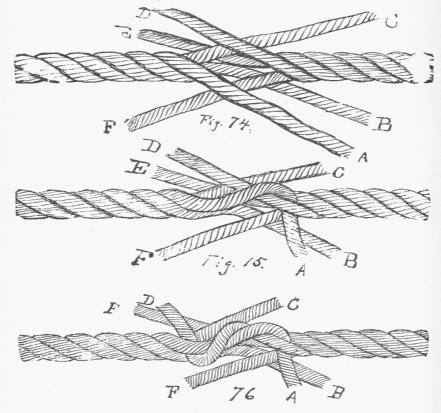
Every farmer and every farmer's boy ought to be able to splice a rope, make a rope halter, and tie all the useful knots known to the sailor. To splice a rope is a simple matter, but to teach the art on paper is quite another thing. (J.M.Drew, St. Paul Publishing Company 1918.)
Linked lists
Main idea: objects can contain references to other objects.
A node is a simple object that contains data and a reference to the next node. (Node volunteers?)
A linked list is referred to using the address of the first node, the head node. (node_example.py)

Linked lists
Doubly-linked circular list with sentinel:

- Doubly-linked. Why? (splicing, finding previous)
- Circular. Why? (first and last more uniform)
- sentinel: an extra node with no data. Why? (searching)
sentinel_DLL.py
Empty list:
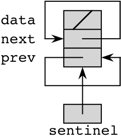
(look at init method)
OMG WHAT IS self.sentinel.next = self.sentinel OMG?
Linked lists: insert
Insertion near beginning of Python list is $\Theta(n)$. How about for linked lists? (Volunteers, again.)
Linked lists: deletion
Deletion near beginning of Python list is $\Theta(n)$. How about for linked lists?
Linked list: searching
linear search.py"find()" method in: sentinel_DLL.py
(Note clever use of sentinel.)