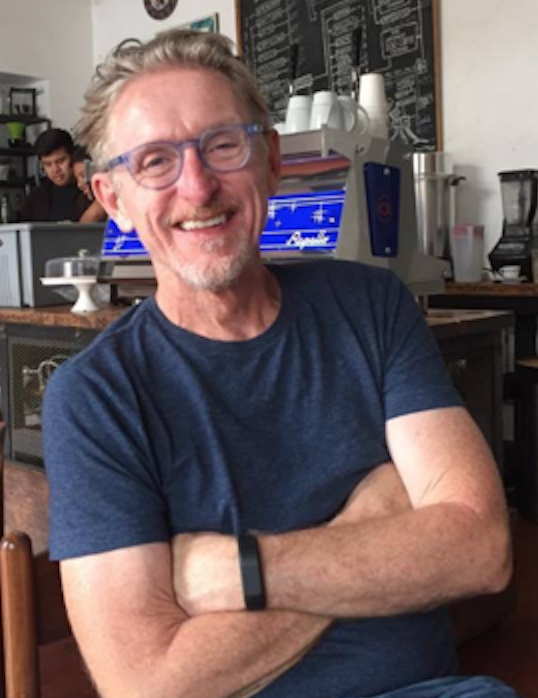
About me
Recently, we received the ACM UbiComp 2024 10-Year Impact Award for the StudentLife study, which "pioneered the integration of mental health research with mobile data mining." and the ACM SIGMOBILE 2019 Test of Time Paper Award for research that "pioneered the application of machine learning across local devices and servers."
At Dartmouth, I co-direct the HealthX Lab and Emerging Technologies and Data Analytics at the Center for Technology and Behavioral Health. Before joining Dartmouth, I spent a decade as a tenured associate professor of electrical engineering at Columbia University, where I worked on mobile computing and wireless networks.
In 2009, my brother, Ed Campbell, died by suicide. At the age of 18, Ed went to Durham University, had his first depressive episode, was diagnosed with bipolar disorder, and dropped out of college. Ed had moments of pure joy in his life, but his mental illness slowly eroded his life. After his death, I switched my research area to studying the mental health of college students and started the StudentLife study at Dartmouth College.
My acceptance speech in Melbourne, where I dedicated the 2024 ACM UbiComp 10-year Impact Award for the StudentLife study to my brother Ed Campbell, who died by suicide in 2009; "His death is something I can now discuss openly, but honestly, I've never fully come to terms with it – I just don’t think you ever do. However, his life – his lovely, messy, complicated life – continues to inspire me and my work every day. For this reason, I dedicate this award to my brother Ed Campbell, the missing author and inspiration behind the StudentLife study".
The StudentLife study was timely because it began in the early years of the emerging mental health crisis among young adults, particularly on college campuses. It is during these college years that young adults are most likely to experience their first mental health episode. As a teacher, I often wondered what was happening behind my students' stressed faces and how we could help.
Before Columbia, I spent ten years in the software industry, leading the development of wireless packet networks and operating systems. I have been a visiting professor at CMU Rwanda, University of Salamanca, University College London, and Cambridge University. During 2016-2018, I joined Google in Mountain View to work on cardiovascular health as a member of the Android wearables group and Verily (formerly Google Life Sciences) as a research scientist working on mental health and AI technology. My research has been covered widely by the popular press (New York Times, Wall Street Journal, Washington Post, Financial Times), TV (BBC, CBS), and radio (NPR, CBC).My research focuses on the development of mobile sensing (phones, wearables), intervention, and AI technology capable of accurately assessing and managing mental illness (e.g., anxiety, depression, schizophrenia) at a population scale.
My research has also received several prestigious awards, including the ACM SenSys 2018 Test of Time Award for ".. pioneering applying machine learning across mobile phones and servers", the ACM SIGMOBILE 2019 Test of Time Paper Award 2019 for “.. inspiring a huge body of research and commercial endeavors that has continued to increase the breadth and depth of mobile sensing”, the ACM 2022 UbiComp 10-year Impact Award for " .. showing how smartphone microphones could be used to recognize stress from the user’s voice unobtrusively" and the 2024 ACM UbiComp 10-year Impact Award for “pioneering the integration of mental health research with mobile data mining”.
I am very fortunate to work with a fantastic group of students and faculty on developing technology to address some of the most pressing problems in healthcare today. I have published over 450 research papers on mental health, ubiquitous computing, wireless networks, sensor networks, and mobile computing and have been awarded research grants totaling $42M from a wide range of agencies (e.g., NSF, NIH, IAPRA) and companies (e.g., Google, Intel, NTT DoCoMo).
During my career I have had the great fortune to closely collaborate with an amazing set of researchers who have inspired me -- starting with Aurel Lazar (Columbia) during my Columbia years when I worked on computer networks, Tannzeem Choudhury (Cornell) in the area of human dynamics and sensing, Dror Ben-Zeev (University of Washington) in the area of mental health, and Xia Zhou (Columbia) in Mobile X.At Dartmouth, I lead the StudentLife project, which involves following 200 students across their four years at Dartmouth using mobile behavioral sensing and brain imaging to better understand depression and anxiety during college.
I live in Vermont with my wife Susan Zak and have two sons Miles and Will.See Google Scholar for my most recent list of publications, citations, h-index, and research ranking at Dartmouth College.
Contact information
- Office: is located Engineer and Computer Science Center Room 011.
- Email: andrewtpcampbell@gmail.com
Sponsors

What's new
Excited about the new NIH R33 grant to improve social functioning for people with serious mental illness, with the brilliant Eric Granholm and Colin Depp at UCSD, April 2025
We have three postdoc openings for an exciting new project on student flourishing using behavioral sensing and LLMs. This opportunity is with Lisa Marsch and Nick Jacobson at Dartmouth’s CTBH April 2025.
Assessing AI-Driven Approaches to Student Mental, Dartmouth News, March 2025
AI & Student Mental Health Symposium @ Dartmouth: I'm co-chairing the AI & Student Mental Health Symposium @ Dartmouth on March 17, 2025.
The StudentLife mental health study won the 2024 ACM UbiComp 10-year Impact Award with the following citation: “This groundbreaking paper has had an exceptional influence and significant impact on the field. It pioneered the integration of mental health research with mobile data mining, addressing real-world challenges in innovative ways. The availability of the dataset to the community also exemplifies exemplary research practices", October 2024.
Media: Professor Andrew Campbell pioneered the use of a smartphone app to track Dartmouth students’ mental health. Dartmouth News, October 2024.
Media: They Entered College in Isolation and Leave in Protest: The Class That Missed Out on Fun, Wall Street Journal April 2024.
Media: AI-powered apps working to detect mental health problems. CBS News April 2024.
Media: Interview about MoodCapture. The Tech Show April 2024.
Late-breaking CHI paper on integrating behavioral sensing into GenAI. The StudentLife study is driven by the idea that smartphones, wearables, machine learning, and AI technology will bridge the gap between the escalating demand for mental health support on campuses and the limited access to healthcare professionals. AI will revolutionize mental illness diagnosis, management, and treatment at scale, both on campuses and globally. Our next step involves integrating real-time human behavioral sensing with GenAI for assessment and intervention; our goal is to help students thrive; for further details, see our upcoming late-breaking CHI paper on MindScape. March 2024.
Significant research milestone: We have released the College Experience Study Dataset and its companion UbiComp paper, which capture the dynamics of the mental health of 200 undergraduate Dartmouth students from high school to graduation. The dataset includes mobile sensing, self-reports, surveys, and brain imaging data, offering a new opportunity to connect 24/7 behavioral sensing from phones to brain activity. I hope releasing this deep behavioral dataset allows other researchers to advance the study of mental health on college campuses. March 2024.
Media: Study Tracks Shifts in Student Mental Health During College, Dartmouth, March 2024
I enjoyed talking to the Dartmouth Trustees about innovating in the mental health space with my excellent colleagues Lisa Marsch (Center for Technology and Behavioral Health) and Danny Blanchflower (Economics), Faculty Discuss Mental Health Research Dartmouth, March 2024
Media: Phone App Uses AI to Detect Depression From Facial Cues, Dartmouth, March 2024
Media: Mobile App Predicts Depression By Reading Your Expression, The Times of London, The MoodCapture App May See That You’re Depressed Before You Do, The Daily Beast, AI That Knows How Depression Looks, Politico, This AI App Knows You’re Depressed Before You Do. The Fast Company, March 2024
Digital Mental Health Research Wins Distinguished Paper Award, Presented at ACM UbiComp, October 2023.
Media: A Technology fueled America’s youth mental health crisis, but it can help end it, Washington Post, September, 2023.
Media: A Spotlight on AI and Digital Mental Health and A Symposium Spotlights Digital Tech for Mental Health, September, 2023.
Digital Mental Health & AI Symposium @ Dartmouth: I'm co-chairing the Digital Mental Health & AI Symposium @ Dartmouth, September 19, 2023.
We won the 2022 ACM UbiComp 10-year Impact Award. Our StressSense paper on detecting stress from speech using Android phones won the award with the following citation: “By convincingly showing how smartphone microphones could be used to unobtrusively recognise stress from the user’s voice, this work paved the way for other numerous efforts in the area of stress detection from sensory data, a topic that, 10 years later, is still very relevant for both academia and industry”, October, 2022
NIH/NIDA P30 Center: Emerging technologies and data analytics core director, Center for Technology and Behavioral Health, 2022
Keynote: "Moonshot for Mental Health", Amazon Lab126 Camera & Sensors Tech Summit. November, 2022.
Media: Pandemic exposed mental health divide among college students, study says, Washington Post, May, 2022.
Media: On a Mission for Mental Health News; Professor’s tech research stems from a personal loss, Dartmouth, June, 2022.
New NIH/NIMH grant on Context-Aware Mobile Intervention for Social Recovery in Serious Mental Illness, January, 2022.
Keynote: Assessing the Mental Health of College Students using Mobile Sensing, Health Data Science Symposium at Harvard, November, 2021.
Media: Wearable Tech Confirms Wear-and-Tear of Work Commute, Dartmouth College, November 2021.
Media: Rates of anxiety and depression among college students continue to soar, researchers say, Washington Post, June, 2021.
Media: Using Wearable Sensors to Study Workplace Behavior, Tuck, June 2021
Keynote: Future of Mental Health Sensing, Society for Ambulatory Assessment (SAA) Conference, Melbourne, Jan 2020.
Media: Coronavirus has made already-stressed college students even more anxious and depressed, study finds, Washington Post, July, 2020
New ARL grant: 360 Sensing, 2020.
New NIH/NIMH grant on Personalized Deep Learning Models of Rapid Changes in Major Depressive Disorder Symptoms using Passive Sensor Data from Smartphones and Wearable Devices, 2020.
UbiComp 2019: Our forthcoming paper on Differentiating Higher and Lower Job Performers in the Workplace Using Mobile Sensing -- with a superb bunch of researchers lead by Anind Dey, Sidney D' Mello, Munmun De Choudhury, Gloria Mark, Nitesh Chawla and Aaron Striegel -- was featured in the Washington Post, Financial Times, New Scientist, Tech Crunch, Boston Globe, Bloomberg, Medium OneZero and more. The Dartmouth team on the paper was lead by Shayan Mirjafari and in collaboration with Tuck Professor Pino Audia, August 2019.
Named to the Albert Bradley 1915 Third Century Professorship: Very honored to be appointed to the endowed chair in memory of Albert Bradley and also humbled because my colleague, the brilliant Hany Farid, held this chair before moving to UC Berkeley, July 2019.
ACM SIGMOBILE Test of Time Paper Award 2019: "CenceMe was the first paper to demonstrate how smartphones can be used to derive rich behavioral insights continuously from onboard sensors. Since its publication, the work has inspired a huge body of research and commercial endeavors that has continued to increase the breadth and depth of personal sensing. Some of the activity inference methods that are now common in smartphone operating systems can be traced back to the original CenceMe system" (award committee citation), 2019.
SXSW 2019: The Future of Wellbeing with Ubiquitous Sensing with Gloria Mark, Tanzeem Choudhury and Mary Czerwinski, 2019.
New ARL grant: Capturing Soldier State Through Continuous Smartphone Sensing, 2019.
Media: The perils and promise of staff appraisal by smartphone, Financial Times, July 2019.
Media: Your boss could use your smartwatch to check your productivity levels, New Scientist, July 2019
Google/Verily: Healthcare Faculty Workshop, 2018.
New thesis: Dr. Rui Wang graduated and joined Facebook. I am very proud of Rui and his work. Rui's thesis on Mental Health Sensing using Mobile Phones is absolutely brilliant work. It contains the original StudentLife paper. His thesis is captured in 5 Ubicomp papers, 2018.
Keynote address on Future of Mental Health Sensing on College Campuses, HotMobile, 2018.
ACM SenSys Test of Time Paper Award: Our CenceMe paper, cited by the awards committee: "pioneered applying machine learning across local devices and servers", 2018.
New NSF grant: Sensor-Based Assessment of Behavioral Lifestyles and Experiences, 2018.
New NIMH grant on Effort-based Decision Making and Motivated Behavior in Everyday Life. 2018.
Teaching a new seminar in applications of data science, 2018.
Completed 3 marathons this year brings me to 13, 2018.
Media: Dartmouth Computer Scientist at Forefront of Sensing Revolution, Valley News, 2017.
New NIMH grant on Mobile RDoC: Using Smartphone Technology to Understand Auditory Verbal Hallucination, 2016.
New NIMH grant on Functional Anatomic Studies of Self-Affect: A Multimodal Approach, 2016.
New IAPRA grant on Comprehensive Modeling for Job Performance via Sensing, 2016.